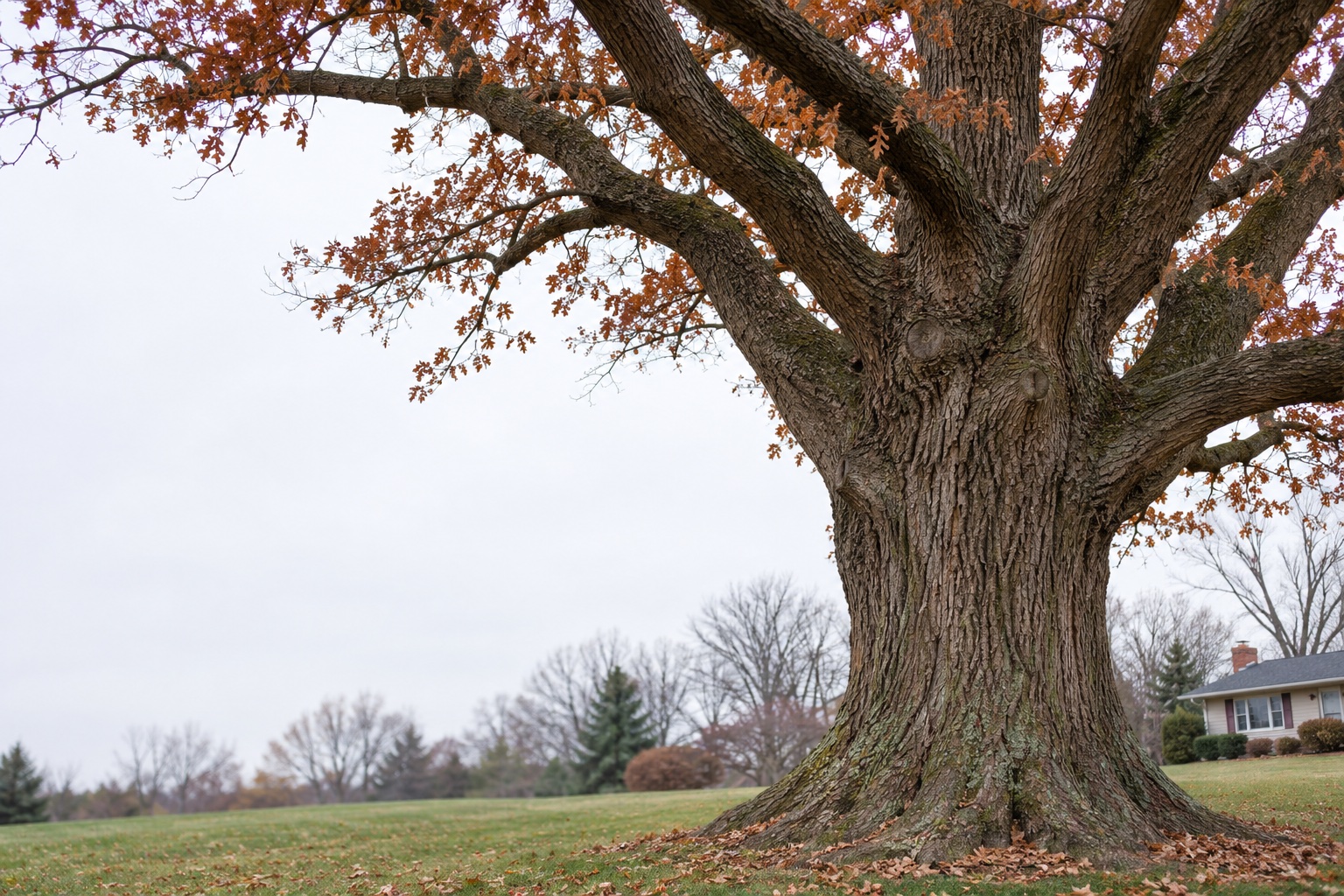
A mature cottonwood is usually the biggest tree on the block, and taking one down is a big-tree job from start to finish: it comes down in sections, and what is around it decides how. Here is what makes cottonwoods different and what to expect.
How big they get
The Kansas Forest Service gives the eastern cottonwood, the Kansas state tree, a mature height of 70 to 100 feet and a spread of 50 to 70 feet, and says it often grows as much as 8 feet a year with enough moisture (Kansas Forest Service).
Why people take them out
- The wood is weak. The U.S. Forest Service says so in four words: "the wood is weak" (USFS). Big limbs on a tall, fast-grown tree are a lot of weight on wood that does not hold it well.
- The roots go looking for water. The same Forest Service sheet warns that the extensive root system may enter and clog water and sewer lines.
- The cotton. Each spring the seeds drift on cottony fluff, and a big tree can leave what the Forest Service calls a snow-like drift of seed-cotton across yards.
Hazard or nuisance?
A cottonwood dropping cotton is a nuisance. A cottonwood with dead limbs in the crown, cracks at the main forks, a cavity at the base or a new lean toward the house is a hazard. The difference decides how soon it should come out. The checklist is on dead and hazardous tree removal.
How a cottonwood comes down
Size and weight are what make a cottonwood a serious job. A 90 foot tree has heavy limbs high in the crown, and every one of them has to come down in a controlled way. In an open yard, sections can be lowered on ropes into clear ground. In a tight yard, or with a house, garage or wires underneath, a crane lifts the sections out instead, and the crew has crane and bucket truck access for those jobs. See crane-assisted tree removal. The size guide helps you estimate how tall yours is before you ask for a quote.
Cottonwoods by the street
Some cities treat cottonwood as a poor street tree. Prairie Village's street tree policy lets an owner request removal of a right-of-way tree because it is an "undesirable" species such as cottonwood, with the owner paying for the removal and arranging a replacement tree in advance (Prairie Village policy). Other cities have their own rules; see the permit guide.
Grinding the stump
A cottonwood stump is big, and the surface roots around it can be bigger than people expect. We grind stumps; see stump grinding.
What a cottonwood costs to remove
A mature cottonwood falls in the two highest published national height tiers: the 60 to 80 foot tier runs $800 to $1,500, and the tier above 80 feet runs $1,000 to $2,000. A tight yard can add 25% to 50%, and a crane adds about $250 to $600 per day. The same published guide also says difficult crane jobs can run $6,000 to $7,000 in total, which is a better guide for the biggest trees in the hardest spots. The cost guide works through an 85 foot cottonwood as an example. Back to the home page, or see other big species.
Cottonwood questions
Can you remove a cottonwood without a crane? Often, yes. If there is open ground to lower sections into, it can come down with ropes and climbing or a bucket truck. A crane comes in when there is no safe place to lower anything. The quote tells you which.
Is cottonwood worth anything as lumber or firewood? Not much. The Kansas Forest Service says the lumber goes to pallets and low-grade construction, and as firewood it is easy to split but burns quickly with low heat.
Will removing it stop the cotton? From that tree, yes. Cottonwood seed travels on the wind, so a neighbor's tree can still send some your way.
Get a cottonwood quote
Send a photo of the whole tree, standing far enough back to see the top.