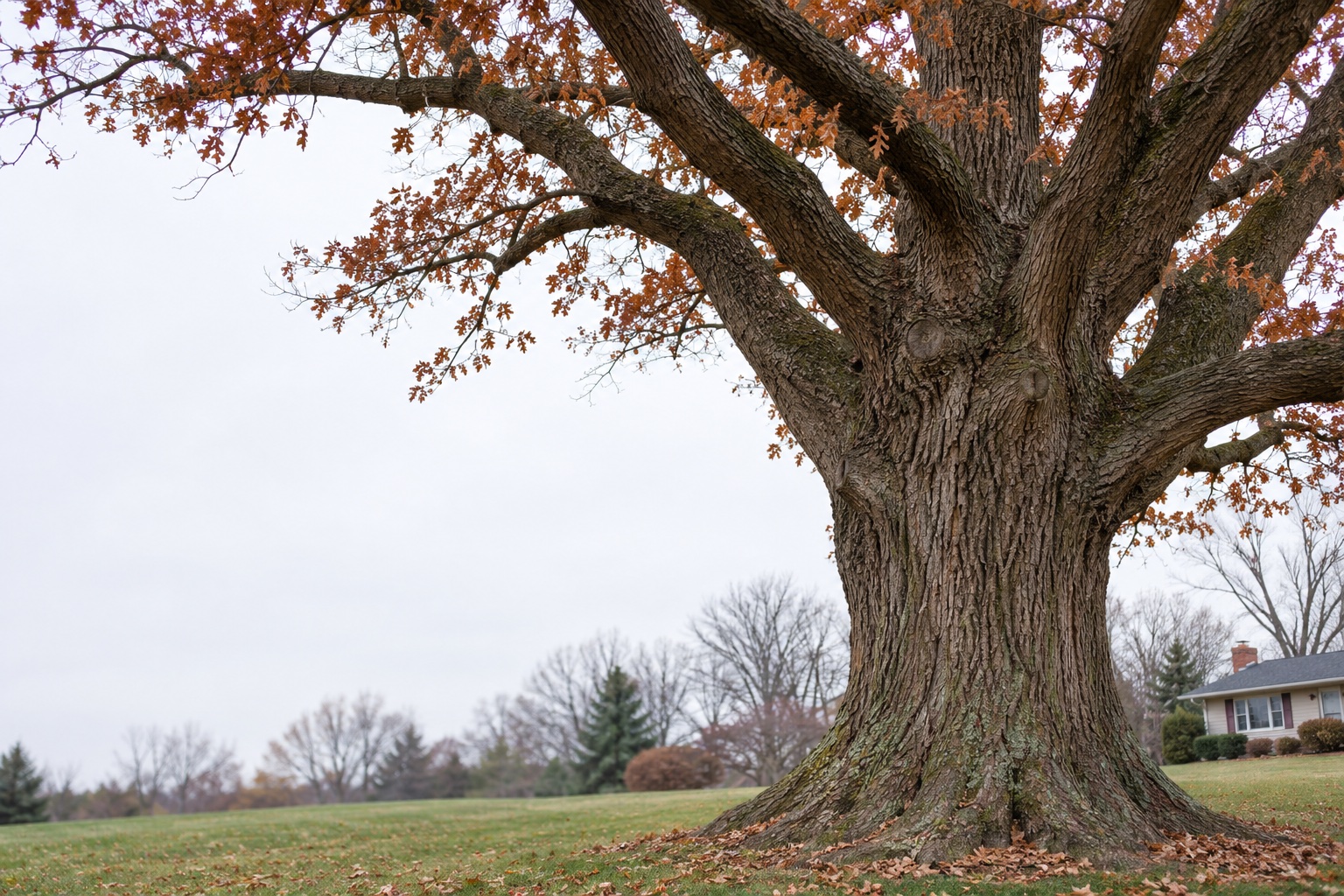
Kansas City's tree damage mostly comes from straight-line wind in summer thunderstorms and from ice in winter. Both find the same weak spots: brittle species, dead wood, and limbs joined to the trunk at narrow angles. Here is what the worst recent storm did, which trees tend to break, and how to check yours before the next one.
July 14, 2023: the storm that set the bar
On the afternoon of July 14, 2023, a squall line crossed the metro. The National Weather Service recorded a peak gust of 89 mph near Shawnee, with a trained spotter reporting gusts around 70 mph for 20 minutes, and gusts of 75 to 80 mph estimated just north of Leawood (NWS Kansas City). Nearly 200,000 people across the metro lost power at some point.
The Weather Service logged large trees falling onto houses in Stilwell, Glenaire, Maywood and Oak Grove within about 40 minutes. Evergy said outages peaked at 186,000 customers, the largest storm outage event since the company was formed (Evergy).
Storms like that are not rare here. On August 19, 2026, an overnight storm in Kansas City, Kansas put a tree onto a pair of homes and brought down power lines across the city (KCTV).
How wind and ice break trees
Wind pushes on the whole crown at once. A tree in full leaf catches the most wind, and the force concentrates where limbs join the trunk and at the roots. Weak joints tear; shallow or damaged roots let the whole tree tip.
Ice adds weight rather than push. A coating of ice on every twig adds a lot of weight, and brittle wood snaps under it.
Which trees fail first
The Missouri Department of Conservation's field guide names the usual suspects:
- Silver maple: soft wood and brittle branches; it easily loses limbs in strong winds and ice storms (MDC).
- Siberian elm: fragile wood that breaks easily in storms or under ice, with large limbs splitting from the crotches of older trees (MDC).
- Cottonwood: the U.S. Forest Service calls the wood weak, on one of the tallest trees around (USFS).
- Any dead or declining tree, whatever the species, because dead wood snaps instead of bending.
More on each in Kansas City's big trees, species by species.
A ten-minute check before storm season
Walk around each big tree near the house and look for the signs a Missouri Department of Conservation forester lists (MDC):
- Dead branches or thin, leafless sections in the crown.
- A lean, especially a new one.
- Cracks, splits, cavities or missing bark on the trunk.
- More than two trunks from one point.
- Raised or cracked soil at the base, or sawdust there.
- Shelf mushrooms on the trunk or roots.
- Broken limbs hanging in the crown.
Then look up and ask what each big limb would hit if it came down. A dead limb over the lawn is a project; a dead limb over the bedroom is a priority. The full checklist is on dead and hazardous tree removal.
After the storm
Safety first, then photos, then calls: the utility for wires, the city for street trees, your insurer for damage. The steps are on emergency and storm tree removal, and what insurance usually covers is in the insurance guide. If a tree is on the house, see a tree on your house.
Can a storm-damaged tree be saved?
Often. The Missouri Department of Conservation's rule of thumb is that a tree that has lost more than 40 or 50 percent of its limbs, or has a split trunk, will likely need to come down, and that trees can recover from less (MDC). The same foresters suggest getting at least two estimates and being cautious of non-professionals offering to remove storm damage.
Sources
- National Weather Service Kansas City, July 14, 2023 wind storm through Kansas City.
- Evergy, storm restoration update, July 15, 2023.
- KCTV, Fallen trees damage homes, knock out power in Kansas City, Kansas, August 19, 2026.
- Missouri Department of Conservation, MDC foresters urge caution in removing downed tree limbs, December 16, 2021.
- Missouri Department of Conservation, hazard tree signs, May 24, 2018; field guide pages linked above.
- U.S. Forest Service, Eastern cottonwood.