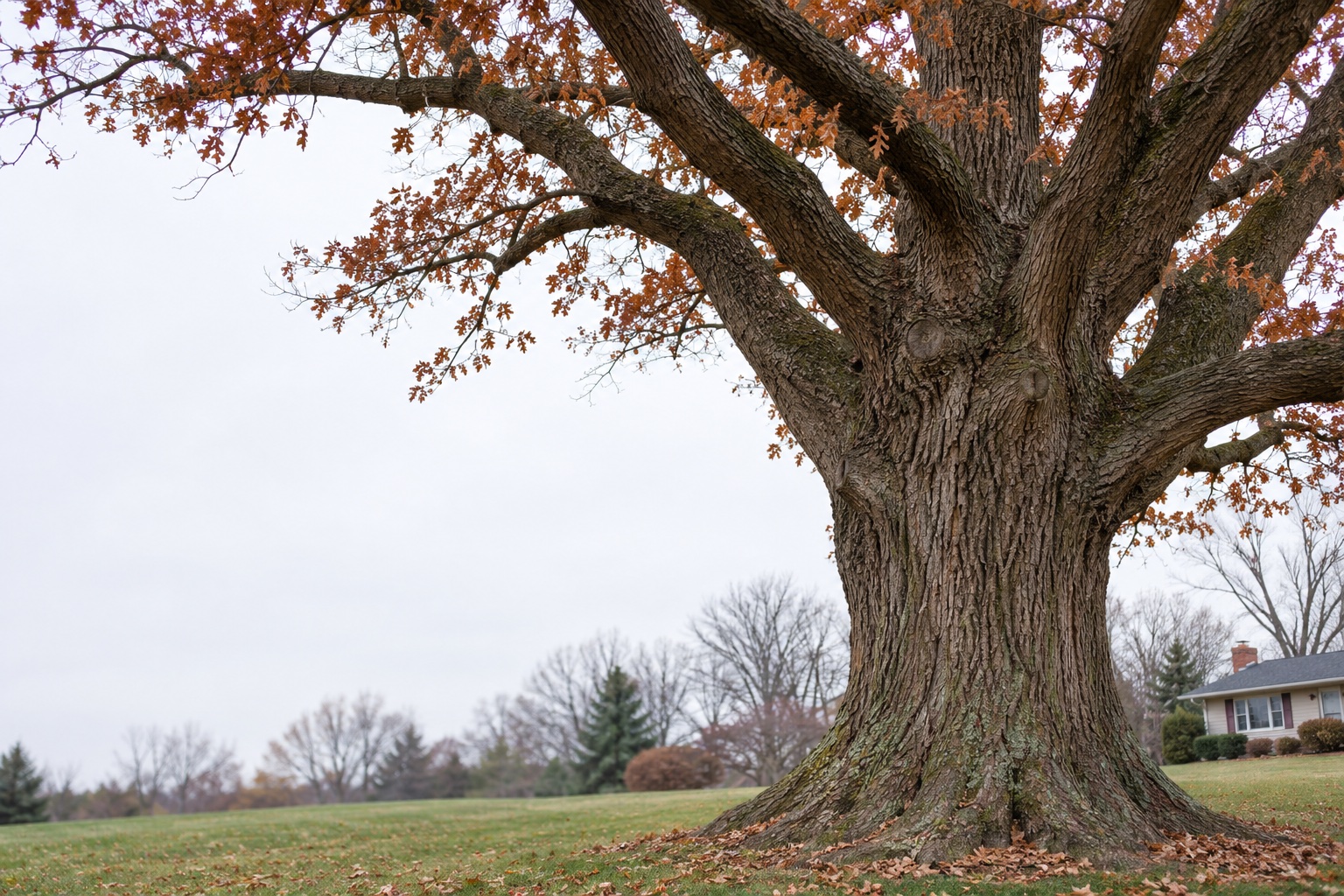
A dead tree is not always an emergency, but it never gets safer. Dead wood dries, cracks and drops in pieces, and a dead tree near a house, a drive or a play area should come out on your schedule rather than the weather's. Here is how to read the warning signs, why a dead tree is a different job, and how to get it gone.
Signs a tree is a hazard
A Missouri Department of Conservation community forester's checklist, in the order you can see it (MDC):
From a distance, look at the crown
- dead branches
- sections with no leaves, or thin leaf cover
Look at the lean
- a tree that leans can be dying or at risk of falling
Walk up to the trunk
- cavities, cracks or splits
- missing bark
- more than two trunks, which can mean the tree is splitting apart
- deep hollows near the ground
- dead branches on the ground, or broken ones hanging in the crown
Check the base and roots
- raised or cracked soil at the base
- sawdust at the base, a sign of ants or borers
- shelf mushrooms or other fungi on the roots, trunk or branches (mushrooms growing from the soil nearby are normal)
- carpenter ants, which nest in dead wood
One sign is a reason to look closer. Several together, with something valuable underneath, is a reason to call.
Dead is not the same as dangerous today
What turns a dead tree from a project into an urgent job is what it would hit. A dead tree at the back of a big lot, leaning away from everything, can usually wait for a dry week. The same tree leaning toward a bedroom, the driveway or the neighbor's garage should not.
Why a dead tree is a different job
Live wood bends; dead wood snaps. A dead tree cannot be trusted to hold a climber's weight or to hold the ropes used to lower sections, and dead limbs can break off while the tree is being worked. So dead trees are often taken down with more of the work done from a bucket truck or with a crane lifting sections clear, keeping people out of the tree itself. The crew has bucket truck and crane access for exactly that. Your quote tells you which method your tree needs.
The usual suspects in Kansas City yards
- Silver maple. Fast-growing, up to 100 feet tall, with soft wood and brittle branches; the Missouri Department of Conservation says it easily loses limbs in strong winds and ice storms (MDC).
- Pin oak. Up to 100 feet tall. In alkaline soil it suffers from iron chlorosis, which leads to poor health and yellow leaves (MDC).
- Siberian elm. Up to 60 feet, with fragile wood that breaks easily in storms or under ice; large limbs can split away from the crotches of older trees (MDC).
- Cottonwood. The U.S. Forest Service says plainly that the wood is weak (USFS). See cottonwood tree removal.
More on each is on Kansas City's big trees, species by species.
Ash killed by the emerald ash borer is handled differently and is not covered on this page.
Who decides a tree is dead or dangerous?
A certified arborist or your county extension office can assess a tree. We are a removal service and do not sell tree assessments. What we can tell you from photos is how the tree would come down and what it would cost.
Cost of removing a dead tree
Published national figures put a diseased tree with soft wood at $400 to $900, and note that structural problems can add up to 15% to the cost. Height and what is underneath still drive most of the price. The cost guide has the full breakdown and an instant estimate. If you are not sure whether a city can require you to remove a dead tree, see the permit guide. Start over at the home page, or read emergency and storm tree removal if it is already coming apart.
Dead tree questions
Can a dead tree wait until winter? Sometimes. If nothing valuable is within reach of it and it is not shedding limbs, a few months may be fine. If it leans toward the house or is dropping branches, waiting is the risk.
Will the city make me remove a dead tree? Some cities can require an owner to deal with a tree that is a hazard to the public, for example one hanging over a street or sidewalk. The permit guide covers what each city's rules say.
Am I liable if it falls? That is a question for your insurance agent. Missouri's insurance department notes that when a tree was dead or diseased and the owner is accused of negligence for not removing it, assigning responsibility gets more complicated (Missouri DCI).
Get a dead tree removed
Send a photo of the whole tree and what is under it.