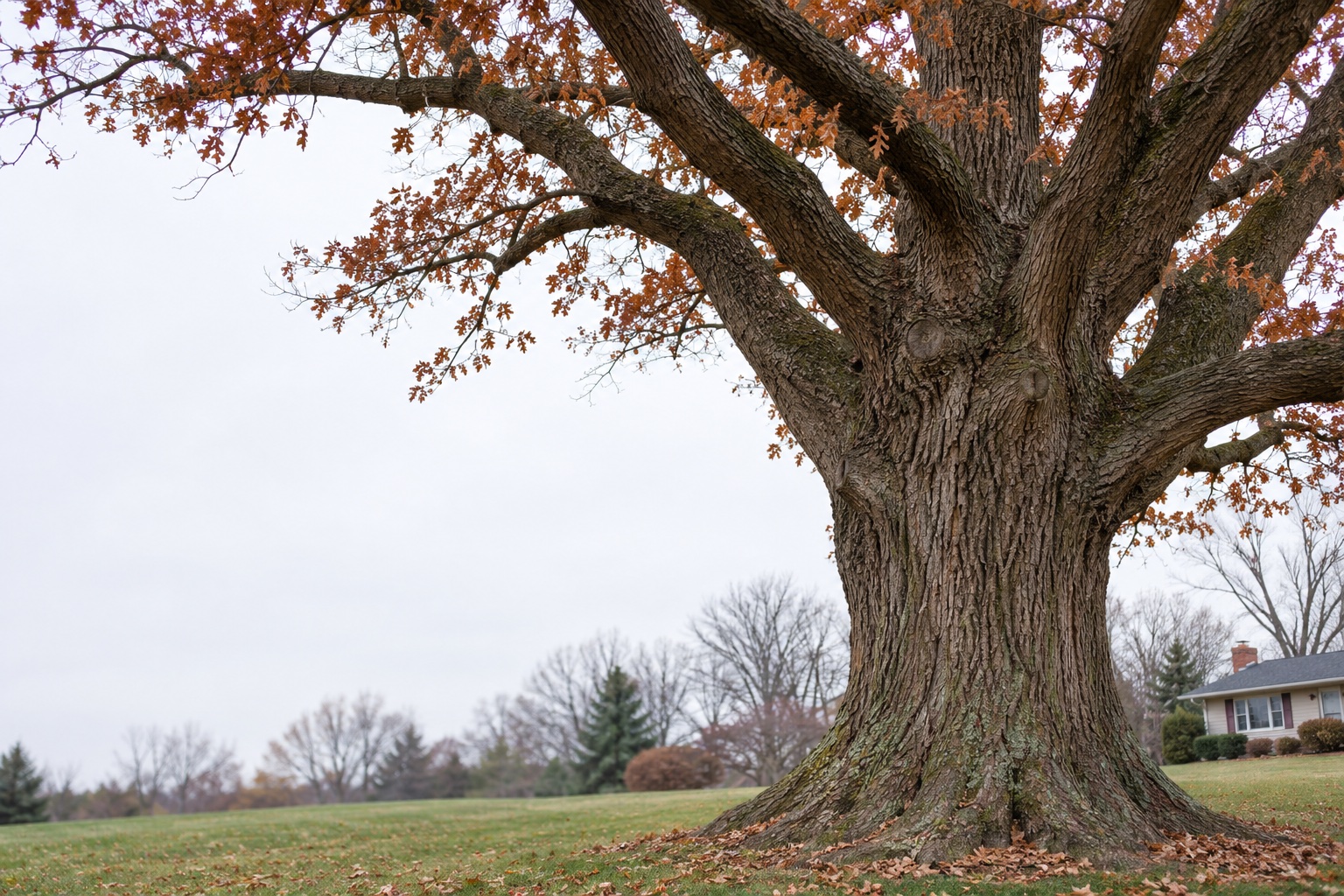
A published Kansas City cost page puts the average tree removal at $694, with most jobs between $185 and $1,850. Large trees cost more than that average suggests: published national tables put a 60 to 80 foot tree at $800 to $1,500 and anything over 80 feet at $1,000 to $2,000, before a crane, a tight yard or the stump.
Before you read the tables
- Where most jobs land: $185 to $1,850 in Kansas City, per published local figures; big trees start near the top of that.
- What moves the price most: the tree's height, then what it would land on.
- What people leave out of the budget: the crane day, the stump, and a street-tree permit.
- Fastest way to a real number: the instant estimate below, then photos for a written quote.
| Service | Removing one large tree, cut and hauled |
| Market | Kansas City metro, Kansas and Missouri |
| Basis | Sourced market range from published figures |
| Kansas City average (published) | $694; most $185 to $1,850 |
| Low scenario | A 30 to 60 ft tree in an open yard: $450 to $1,200 |
| High scenario | An 85 ft tree behind a fence that needs a crane: $1,500 to $3,600 on the published lines, and more on a hard crane job |
| Method | Where these numbers come from |
In one paragraph. Tree removal in the Kansas City area averages $694 on a published Kansas City cost page, but tall trees run higher: published national tables put trees 60 to 80 feet tall at $800 to $1,500 and trees over 80 feet at $1,000 to $2,000. A tree close to a house or in a tight yard can add 25% to 50%, a crane adds about $250 to $600 a day, and the first stump is $100 to $150 more. Those are published ranges, not our price list; for the very largest trees in the hardest spots, the same national guide notes crane jobs reaching $6,000 to $7,000, so treat the tables as the floor of the conversation. Your written quote, based on photos of your tree, is what governs.
Three big-tree jobs, worked through
| Example | How the range is built | Range |
|---|---|---|
| A 45 ft silver maple in an open back yard | 30 to 60 ft tier; nothing underneath; stump left | $450 to $1,200 |
| A 70 ft pin oak ten feet from the house | 60 to 80 ft tier ($800 to $1,500), plus 25% to 50% for working over the house | $1,000 to $2,250 |
| An 85 ft cottonwood behind a fence, lifted out by crane | Over 80 ft tier ($1,000 to $2,000), plus 25% to 50% for the tight yard, plus one crane day ($250 to $600) | $1,500 to $3,600 |
Each row adds up the published lows and highs to show how the factors stack. None is a job we did, and none includes the stump.
The height of the tree
Taller trees take more cuts, more rigging, more hours and more hauling. The published national figures:
| Tree height | Published national range |
|---|---|
| Up to 30 ft | $150 to $450 |
| 30 to 60 ft | $450 to $1,200 |
| 60 to 80 ft | $800 to $1,500 |
| Over 80 ft | $1,000 to $2,000 |
Cottonwood, sycamore, pin oak and silver maple can all grow past 80 feet; the species page has the published mature heights.
The same guide notes very tall trees can reach $10,000.
Kansas City numbers, side by side
The same publisher also has a Kansas City, Missouri page with lower local tiers. We show it as its own table and do not mix it into the national figures or the estimate below.
| Tree height | Published Kansas City range |
|---|---|
| Up to 30 ft | $150 to $350 |
| 30 to 60 ft | $350 to $1,000 |
| 60 to 80 ft | $650 to $1,250 |
| Over 80 ft | $800 to $1,650 |
Same page: average $694, most jobs $185 to $1,850, labor about $30 to $90 an hour.
What it would land on
This is the factor that surprises people. A tree in an open yard can be dropped in large pieces. The same tree over a roof, a fence or a neighbor's garage has to come apart in small sections, each tied off and lowered, which takes far more time. The published national guide says a tight, hard-to-reach or unsafe spot adds 25% to 50%.
| Setting | Effect on price (published) |
|---|---|
| Open yard with room to drop sections | Height tier only |
| Over a house, garage or fence, or in a tight back yard | Height tier plus 25% to 50% |
The crane day
When there is nowhere to lower the pieces, a crane lifts them out. The published national guide lists crane service at about $250 to $600 per day, and says total crane jobs on difficult trees run about $6,000 to $7,000. A crane adds a line to the bill, but on a big tree it can also shorten a job that would otherwise mean a long day of rigging. More on how a pick works: crane-assisted tree removal.
| Crane line | Published national |
|---|---|
| Crane service, per day | $250 to $600 |
| Difficult crane jobs, total | about $6,000 to $7,000 |
Dead, split and storm-broken trees
A dead or split tree is not automatically more expensive, and the published figure for a diseased tree with soft wood is $400 to $900. But dead wood cannot be trusted to hold a climber or a rope, so more of the work moves to a bucket truck or crane, and the same guide says structural problems can add up to 15%. A tree that is already on the ground is cut and hauled: the published range is $300 to $500 for an uprooted or fallen tree. See dead and hazardous tree removal.
Emergency work
Published national figures say emergency removal carries a premium and that urgent cases can reach $5,000. That is a ceiling, not a range, and the gap between a limb in the yard and a trunk through the roof is wide. See emergency and storm tree removal.
By species
| Species | Published national range |
|---|---|
| Oak | $200 to $2,000 |
| Maple | $250 to $2,000 |
| Pine | $250 to $1,500 |
| Cedar | $250 to $1,500 |
The national guide publishes no cottonwood figure; price a cottonwood by its height, usually the top two tiers. See cottonwood tree removal.
Grinding the stump
| Stump | Published national |
|---|---|
| First stump | $100 to $150 |
| Second and later stumps | Priced in your written quote |
Big stumps and their surface roots take longer to grind. See stump grinding.
Permits
The published national range is $60 to $150 for a permit where one applies. In the Kansas City area, permits usually come into play for street trees and for trees removed during construction; the city-by-city rules are in the permit guide. We tell you on the quote whether a permit applies.
Ways to keep the cost down
- Clear the way in. Move vehicles, furniture and anything fragile from the work area and the path from the street.
- Plan it outside storm season. After a big storm, every crew in the metro is busy with emergencies.
- Do two trees on one visit if you were going to remove both anyway; they share the setup and the haul.
Cost questions
Why does the same tree cost more in a back yard? Because everything has to come out through the gate or over the house. Pieces that could be dropped and dragged in a front yard have to be cut smaller, lowered and carried, or lifted out by crane. The published 25% to 50% access line is exactly this.
Is it cheaper to remove two trees at once? Two trees in one trip split the cost of setting up and hauling, and the quote prices both. There is no published discount for doing more than one.
Does the quote include hauling the wood away? Your written quote lists what is included, line by line, so there are no surprises about the wood or the stump.
Why do quotes for the same tree differ by thousands? Usually the method. One company plans to climb and lower every piece, another brings a crane; one includes the stump and haul-off, another does not. Ask each quote to say how the tree will come down and what is left behind.
Where these numbers come from
- Basis: sourced market range. Every number on this page is printed in the national tree removal guide listed under Sources, except the Kansas City table, which comes from the same publisher's Kansas City page.
- Geography: national figures, with the Kansas City page shown separately. The two are never combined in one number.
- Included in the ranges: felling and hauling. Priced separately: stump, crane day, permit.
- Reviewed: November 2026.
- What governs: your written quote, based on photos of your tree.
Estimate your tree
Get a range for your tree. No contact details needed.
Choose your tree count and height.
Crane day: $250 to $600
Additional stumps: priced in your written quote
Big-tree range from published national price tables. Photos of the tree, its base and what is under it get you a written quote.
Ranges reviewed November 2026.
Get a Quote