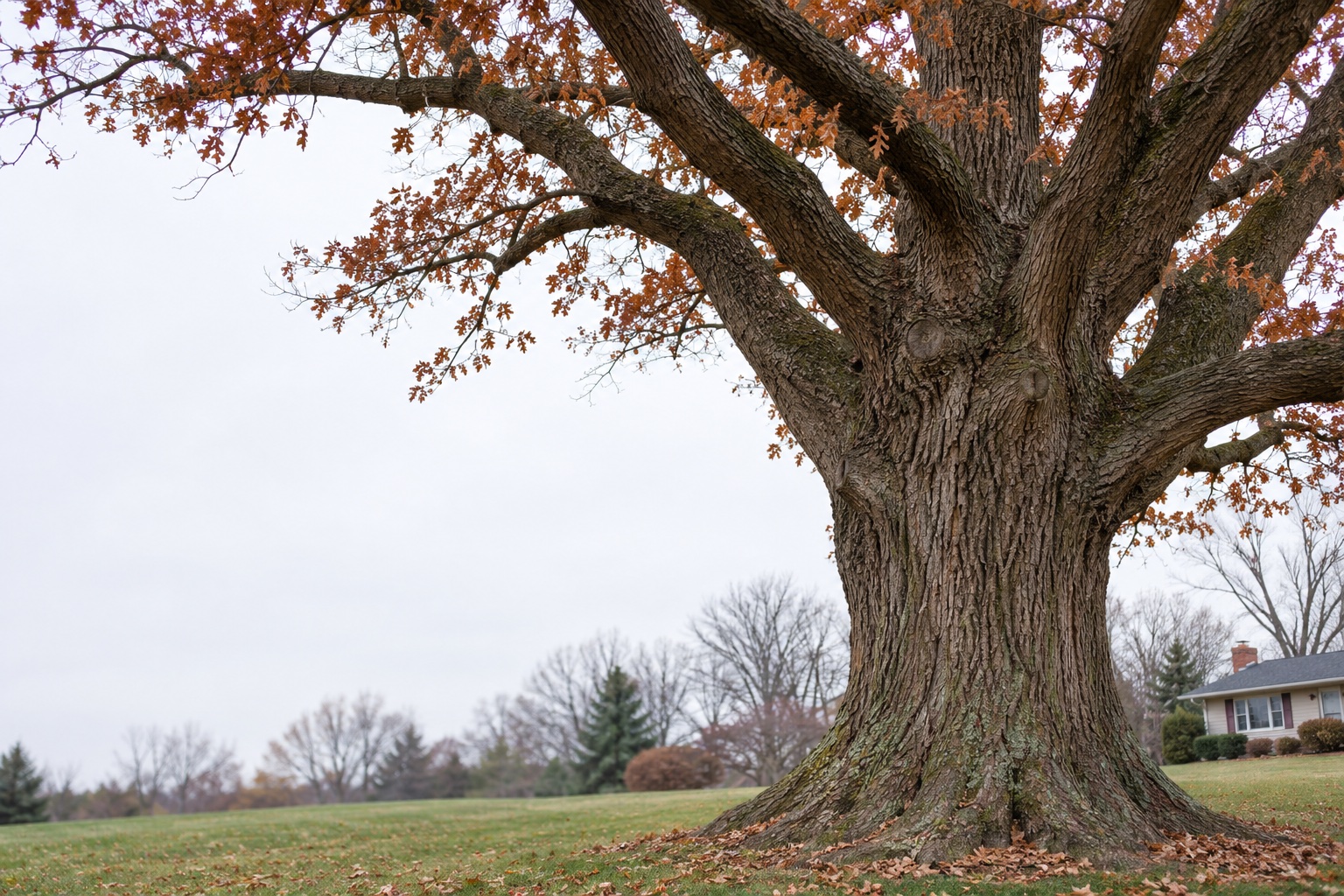
Most of the big trees we take down in Kansas City yards are one of a dozen species. Each one comes down a little differently, because each one grows, breaks and rots in its own way. Here is what to know about yours.
The quick comparison
| Species | Mature height (published) | How it tends to fail or decline | What makes removal harder |
|---|---|---|---|
| Pin oak | Up to 100 ft | Iron chlorosis in alkaline soil, then slow decline | Height; many limbs |
| Silver maple | Up to 100 ft | Brittle limbs break in wind and ice | Soft wood; big spreading crown |
| Sycamore | Up to 120 ft | Big old trees are often hollow | Sheer size; trunk diameter |
| Siberian elm | Up to 60 ft | Brittle wood; limbs split from crotches | Unpredictable breaks |
| American elm | 70 ft or more | Dutch elm disease | Dead wood if diseased |
| Hackberry | 60 to 70 ft on good soil | (no specific failure published) | Height near houses |
| Black walnut | About 90 ft | (valued, not fragile) | Owners hoping to sell the wood |
| Sweetgum | Up to 130 ft, 60 ft spread | Spiny fruit is the usual complaint | Height |
| Pines (Scots, Austrian) | varies by species | Pine wilt kills quickly | Dead pines must be disposed of properly |
| Eastern redcedar | Up to 50 ft | Spreads into unburned grassland | Dense, low branches |
Heights: Missouri Department of Conservation field guide, except hackberry (Kansas Forest Service). Pine wilt: Kansas Department of Agriculture. Links in each section below.
Pin oak
A tall, straight trunk and a pyramid-shaped crown, up to 100 feet, with lower limbs that droop, middle limbs that stick straight out and top limbs that angle up (MDC). It grows faster than other oaks. Its weak point in Kansas City is the soil: in alkaline ground, pin oaks develop iron chlorosis, with yellowing leaves and declining health. A tall pin oak that has been yellow for years and is losing its top is a common removal. Because it holds so many limbs along the trunk, it takes a lot of cuts to bring down, and height near a house usually means sectional work or a crane.
Silver maple
Planted everywhere for fast shade, the silver maple reaches up to 100 feet. The Missouri Department of Conservation is blunt about the trade-off: the wood is soft, the branches are brittle, and the tree easily loses limbs in strong winds and ice storms (MDC). It even advises planting slower-growing trees such as oaks alongside it, so they are established when the maples decline. Maples are common enough that Overland Park took them off its approved street tree list, because they made up about a third of the city's street trees (KCUR). On removal day, a silver maple's wide crown over a roof is the main challenge.
Sycamore
The Missouri Department of Conservation says the sycamore reaches the largest size of any deciduous tree in the United States, up to 120 feet, and that many of the largest, over 100 years old, are hollow (MDC). A hollow trunk changes how a tree is taken down, because the wood that would normally hold a rope or a cut is not there. A big sycamore near a house is one of the trees where a crane earns its cost. See crane-assisted tree removal.
Elm: Siberian and American
Siberian elm grows to about 60 feet and is the weaker of the two. Its wood is fragile, it breaks easily in storms or under ice, and large limbs on older trees can split away from the crotches (MDC). It also seeds heavily and spreads where it was never planted.
American elm can reach 70 feet or more, but Dutch elm disease, which arrived around 1930 and is spread by elm bark beetles, has killed nearly all the large old elms (MDC). A big American elm that has started wilting branch by branch is often a removal, and the dead wood calls for the cautious methods on our dead tree page.
Hackberry
Recognizable by its gray bark covered in wart-like bumps, hackberry can reach 60 to 70 feet on good soil and is drought resistant on upland sites (Kansas Forest Service). It is a tough, common tree that mostly comes down because of where it grew: a volunteer seedling along the foundation or fence that became a 60 foot tree.
Black walnut
Black walnut reaches about 90 feet, and the Missouri Department of Conservation calls it Missouri's most valuable tree, with wood in high demand for furniture, veneer and gunstocks (MDC). That is why owners often ask whether a yard walnut is worth money. The honest answer is that it depends on the log and on finding a buyer who wants it, and we are not log buyers. If selling the wood matters to you, talk to a buyer before the tree comes down. Walnuts also produce juglone, a chemical that stunts or kills many plants growing nearby, which is a common reason they come out of gardens.
Sweetgum
Sweetgum can reach 130 feet with a 60 foot spread, and its spiny, inch-wide seed balls hang on through winter (MDC). The department notes that many people passionately dislike the fruit, which can clog drains, interfere with mowing and hurt bare feet. It is a sturdy tree; the usual reason to remove one is the litter, or the size it reached over a patio or pool.
Pines
Pines in Kansas City yards are mostly planted species such as Scots and Austrian pine, and the main killer is pine wilt. The Kansas Department of Agriculture says pine wilt usually kills a pine within a few weeks to a few months, that there is no effective cure, and that dead pines should be removed promptly and burned, buried or chipped so they do not spread the disease (KDA). A pine that browned out over one summer should come down before the next one.
Eastern redcedar
Eastern redcedar grows to about 50 feet, and the aromatic red wood is used for chests and closets (MDC). It spreads into unburned prairies and fields, so cedars often appear along fence lines and in the back of larger lots. Their dense, low branches mean a lot of cutting before the trunk can come down.
Cottonwood
The biggest of them all gets its own page: cottonwood tree removal.
What removal costs by species
Published national ranges cover a few species: oak $200 to $2,000, maple $250 to $2,000, pine $250 to $1,500 and cedar $250 to $1,500. Height and what is underneath move the price more than species does. The cost guide and the size guide explain why. Back to the home page.
Not sure what you have?
Send a photo of the bark, a leaf and the whole tree with your quote request, and we will tell you.