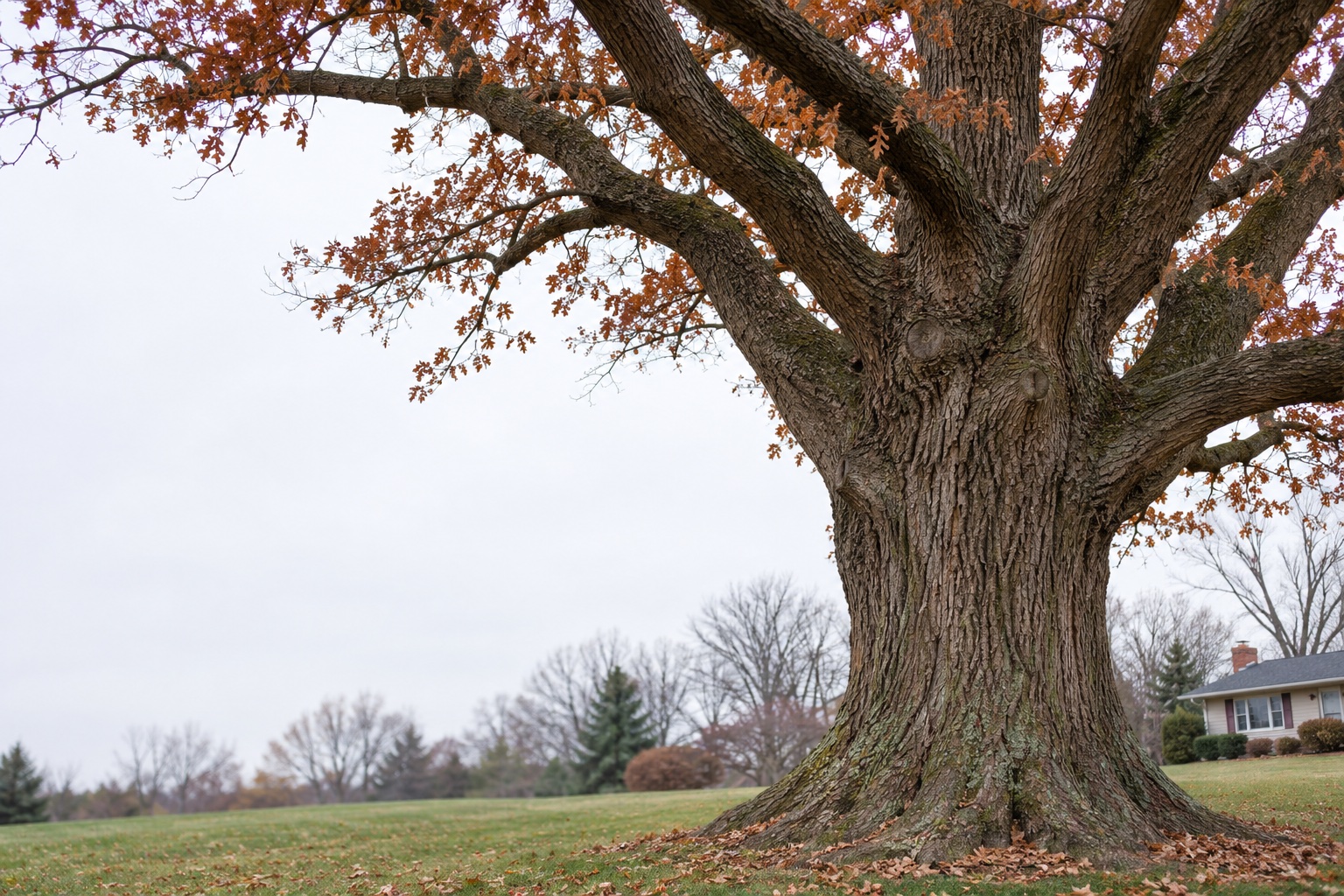
Height is the single biggest thing that sets how a tree comes down and what it costs. You do not need special tools to get close: a stick, a shadow or the house next to it will do. Here is how, and what the numbers mean.
Three ways to estimate height from the ground
Foresters use instruments, but simple sighting methods like the stick method and the pencil method are standard field techniques, listed alongside clinometers and laser rangefinders in Texas A&M Forest Service measurement guidelines (Texas A&M Forest Service). They get you within the right price tier, which is all a quote needs.
1. The stick method
- Hold a straight stick at arm's length, straight up, with the length above your hand equal to the distance from your hand to your eye.
- Walk backward from the tree until the top of the stick lines up with the top of the tree and your hand lines up with the base.
- Your distance from the trunk is roughly the tree's height. Pace it off or use a tape.
2. The shadow method On a sunny day, measure your own shadow and the tree's shadow at the same moment. Tree height equals your height times the tree's shadow length, divided by your shadow length. A 6 foot person casting an 8 foot shadow next to a tree casting a 100 foot shadow means a tree about 75 feet tall.
3. Count the stories Using about 10 feet per story as a rule of thumb, a tree that tops out about twice as high as the peak of a two-story roof is well into big-tree territory. This is the roughest method, but it is fine for a first look.
Trunk diameter: measure at 4.5 feet
Foresters measure trunk thickness at 4.5 feet above the ground, called diameter at breast height. With an ordinary tape: wrap it around the trunk at 4.5 feet, keep it level, and divide the circumference by 3.14 (Texas A&M Forest Service). If the trunk forks below 4.5 feet, measure each stem.
Diameter matters because it tells you how heavy the wood is. Two trees of the same height can be very different jobs if one trunk is twice as thick.
What counts as "large"
We call a tree large when it is taller than about 60 feet, which is where the two highest published price tiers begin, or when it cannot be felled in one piece because of what is underneath it. A 40 foot tree leaning over a bedroom is a large-tree job, even if a 40 foot tree in an open field is not.
How size changes the method
| Situation | Usual method |
|---|---|
| Smaller tree, open ground all around | Felled whole or in a few big pieces |
| Tall tree, some open ground | Taken down from the top in sections, lowered on ropes |
| Tall tree with no open ground, or over a house | Sections lifted out by crane |
The crew has bucket truck and crane access, so the method follows the tree rather than the other way around. See crane-assisted tree removal for how a lift works.
How size changes the price
Published national figures by height:
| Height | Published national range |
|---|---|
| Up to 30 ft | $150 to $450 |
| 30 to 60 ft | $450 to $1,200 |
| 60 to 80 ft | $800 to $1,500 |
| Over 80 ft | $1,000 to $2,000 |
Tight access, a crane and the stump add to those. The cost guide shows how.
What to send for a quote
- The whole tree, from far enough back to see the top.
- The base of the trunk, with something for scale.
- What is underneath: roof, fence, drive, wires.
- The way in from the street.
- Your height estimate, if you made one.
Related: cottonwood tree removal (the tallest tree in most neighborhoods), Kansas City's big trees by species, and the home page.
Sources
- Texas A&M Forest Service, Tree Measurement Guidelines.